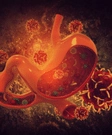
Stomach Cancer in India
Stomach Cancer (also called as Gastric cancer) is characterised by growth of cancerous cells in the lining of the stomach
What is Stomach Cancer?
Stomach cancer occurs when some cells in your stomach divide uncontrollably. Most of these cancers occur in the cells that line your stomach.
Your risk of stomach cancer increases with age. Six out of ten people with stomach cancer are above the age of sixty-five. Men are twice more likely to have it than women.
One of the most important problems of stomach cancer is the absence of early symptoms. It makes it difficult to detect it in the early stages.
Surgery is the most common treatment for stomach cancer. If you have treatment in the early stages, your chances of recovering from the disease are good.
What causes stomach cancer?
The exact cause of stomach cancer is not clear. It occurs when cells start dividing uncontrollably. Cancer cells also go on to live for a longer time than healthy cells. Certain changes in the DNA of the cancer cells are the reason why these happen. But why these changes occur is not clear.
Some of the common risk factors for stomach cancer are
- Age- The risk increases with age. Most of those who have stomach cancer are above the age of 65
- Family history- If anyone in your immediate family has a history of stomach cancer, your risk is more
- Food habits- Salty and smoked food can increase your risk. Having a diet with lots of vegetables and fruits is ideal.
- H.pylori infections- Repeated H.pylori infections that cause stomach ulcers increases your risk.
- Smoking- Smoking increases the risk by two times
- History of GERD- If you have an acid-reflux problem, the risk is more
- History of polyps in the stomach
- Inherited conditions like Lynch, Peutz-Jugher, Le-Fraumeni syndromes, etc.
What are the symptoms of stomach cancer?
Some of the common symptoms you may have are
- Feeling less hungry
- Bloating of the stomach
- Severe indigestion
- Heartburn that does not go away with medicines
- Feeling full with even small amount of food
- Losing weight without trying
- Severe fatigue or tiredness
Most of the symptoms of stomach cancer resemble that of other common problems like gastritis, peptic ulcers, etc. It makes early detection of stomach cancer very difficult. If the symptoms are due to other issues, you will get relief with medicines in a short time. But if these do not go away with medicines, you need to take it very seriously.
Diagnosis of stomach cancer
If you have any of the symptoms of stomach cancer, your doctor will make you do a few tests. These tests will help the doctor to confirm whether you have cancer or not.
- Physical examination- The doctor will look into your symptoms, signs, and past medical history. There will also be a risk assessment for stomach cancer as well
- Endoscopy- An endoscope is an instrument that has a small tube and a camera at the end. The surgeon will pass it down your throat and food pipe to the stomach. The doctor will be able to see the inside of your stomach very clearly using this camera. He or she will look for any signs of abnormal tissue growth inside the stomach. If there are any suspicious areas, the doctor will collect samples for biopsy.
- Biopsy- During a biopsy, a pathologist will look into your tissue samples with the help of a microscope. It helps to identify the presence of cancer cells as well as the type of cancer you may have.
- Endoscopic ultrasound- It is an ultrasound scan of your stomach from inside. Your doctor inserts an endoscope with a transducer at the tip into your stomach. Using this tip, the doctor will take ultrasound images of your stomach, nearby lymph nodes, and other adjacent organs. It helps to judge the extent of your cancer more accurately.
- CT scans- It helps to confirm the location as well as to assess the extent of cancer.
- PET scans- You will have this if the doctor suspects that cancer has spread to other parts of your body. Unlike CT or MRI scans, a PET scan helps the doctor to detect possible areas of cancer spread at once.
Treatment for stomach cancer
Your stomach cancer depends on the stage of your cancer and your general health.
Surgeries for stomach cancer
The main surgeries for stomach cancer are
- Endoscopic mucosal resection: It is the option if your cancer is in the early stage and has not spread beyond the lining of your stomach. During the surgery, your surgeon will insert an endoscope through your mouth and throat into your stomach. At the end of the endoscope will be a camera that allows the surgeon to view your stomach lining and thus locate your cancer. The surgeon will then remove the area of cancer with the help of special instruments. Since there is no surgery wound, your recovery will be speedy.
- Partial gastrectomy: It is a surgery to remove the stomach. In a partial gastrectomy, the surgeon will only remove the part of your stomach having cancer. You will have this surgery only if cancer affects only one half of your stomach. During this surgery, the surgeon will also remove the lymph nodes close to your stomach.
- Total gastrectomy: You will need this if the major portion of your stomach is affected. In this surgery, the surgeon will remove your entire stomach. In tumors that have spread to the spleen, parts of the esophagus, intestines, pancreas, and other nearby organs, the surgeon will remove these as well. After removing the stomach, the surgeon will shape a part of the small intestine in the form of a stomach and connect it to the food pipe.
Chemotherapy for stomach cancer
Chemotherapy uses medicines to destroy cancer cells. It is ideal for cancer that has spread through your stomach as well as to nearby organs.
You may have chemotherapy before or after surgery. Having it before surgery will help to shrink your tumor, making the operation easier. If your cancer has spread through your stomach and surgery cannot remove it altogether, you will have chemotherapy after. It helps to destroy the cancer cells that remain after surgery.
You will have chemotherapy in cycles with periods of rest in between. Each cycle will last for a few weeks. The rest period will help you to recover from the side effects of treatment.
Radiation therapy for stomach cancer
Radiation therapy uses very high energy rays or particles to kill cancer cells. It helps to shrink the tumor before chemotherapy or to destroy cancer cells remaining after surgery.
In those with advanced-stage stomach cancers, radiation therapy will help to relieve the symptoms. It thus improves the quality of life by reducing pain, bleeding, and stomach obstructions.
Targeted therapy for stomach cancer
Targeted therapy destroys cancer cells through medicines. It acts by preventing the formation of certain proteins that help them grow. An advantage is that the medicines target only the cancer cells and spares healthy cells. So there will be very few side effects.
Immunotherapy for stomach cancer
This treatment aims to improve the immunity of the body to help it fight and destroy cancer cells. You will have medicines to enhance the body’s immunity.
Prognosis of stomach cancer
Early detection helps to increase the success of treatment. As the stage increases more aggressive treatments are necessary
Top Hospitals for Stomach Cancer
We partner with India's most respected accredited hospitals.




Frequently Asked Questions
Stomach cancer has very few symptoms in the early stages. Some of the common symptoms are reduced appetite, feeling of fullness even with small amounts of food, bloating, etc. Indigestion and heartburn will occur in some. All these symptoms can be due to various other stomach problems. So it is difficult to identify stomach cancer with symptoms alone
Stomach cancers are very much treatable if it is in the early stages. Surgery is the best treatment for early-stage stomach cancer. The surgeon will remove the part of the stomach with cancer. If cancer involves a major part of the stomach, the surgeon will remove the whole of the stomach. This procedure is called a total gastrectomy. Advanced-stage stomach cancers that have spread to other parts of the body will need chemotherapy or radiation
Surgery is the best treatment for early-stage stomach cancer. There are different types of surgeries to treat stomach cancers depending on the extent of spread. The surgeon will remove a part or whole of your stomach with a procedure called gastrectomy. After gastrectomy, the surgeon will reshape a part of the intestine to form a stomach pouch. It helps you to eat and digest food without much problem. You only need to have a healthy diet that is easily digestible
Stomach cancer usually affects those above the age of sixty-five. So your risk increases with advancing age. Males are more likely to have it than women. If you have or had an immediate relative with stomach cancer, your risk is more. Habits like smoking, excessive drinking, etc can also increase the risk. A history of diseases like GERD, stomach polyps, etc also will increase the risk
Get a Free Quote
We respond within 2 working hours.
Request Received!
A coordinator will contact you within 2 working hours.