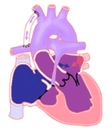
Single Ventricle Defect in India
Single ventricle defect is a congenital heart defect where one side of the heart is underdeveloped
What is Single Ventricle Defect?
Heart defects in children are of many types. Amongst the complex ones, the single ventricles are common. In these kinds of heart defects, the heart is malformed such that there is a mixing of pure and impure blood inside the heart, and the same blood is pumped to the whole body. In addition, the flow to the lungs may be less or much more than normal.
Symptoms that a baby/child with a single ventricle has (will not have all of the symptoms below but a combination of them):
- Failure to gain weight or slow weight gain
- Blue lips, palms, and soles that may become bluer with cold exposure or with crying
- Repeated cough/cold/pneumonia
- Getting tired with mild activities gets tired sooner than playmates
For you to understand the single ventricle better, it is important to know how the normal heart works. See figure 1 below.

The left and the right part of the heart has two chambers each. The top two chambers (RA and LA) are the collecting chambers, while the bottom two chambers (RV and LV) are pumping chambers. Pure blood is pumped by the LV to the whole body. The body’s organs use the oxygen in that blood and make the blood impure. The impure blood returns to the RA and is pumped by the RV to the lungs. When we breathe, the oxygen in our breath enters the blood and makes it pure again. The pure blood enters LA and is pumped out to the body by the LV.
Thus the heart supports two circuits. The left circuit pumps pure blood to the body, and the right circuit pumps impure blood to the lungs.
In single ventricles, the heart malformation is so severe that the pediatric cardiac surgeon cannot separate out the two circuits. Instead, for the past 50 years, they have been bypassing the heart to send blood to the lungs directly. This serves two purposes, the impure blood no longer enters the heart, and only the pure blood is pumped out to the body. This kind of surgery is called Fontan surgery after Dr. Fontan, who first performed it in 1971. Most often, the surgery is done in 2 stages. The first stage is called Glenn surgery, and the second stage is called Fontan surgery. There is a separation of at least 1 year between the two surgeries, in most instances.
Types of single ventricles:
- Tricuspid atresia
- Mitral atresia
- Aortic atresia
- Double Inlet Left Ventricle
- Pulmonary atresia with hypoplastic RV
- Double outlet RV (DORV) with hypoplastic LV or RV
- DORV with remote VSD
- Common AV valve with hypoplastic LV or RV
Diagnosis of Single Ventricle
The echocardiogram is the best test to diagnose single ventricle and is essential. An electrocardiogram (ECG) is important to study the heart rate and rhythm. The pulse oximeter gives the oxygen saturation of the blood circulating in the body.
Rarely, a CT scan of the chest is required to study minute details of the heart vessels. Cardiac catheterization may also be required in some cases.
Glenn surgery:
The impure blood from the upper part of the body returns to the heart via a vein called the SVC. In the Glenn surgery, the SVC is disconnected from the heart and connected to the lung arteries.
Glenn surgery can be performed at any age, earliest being 2-3 months. The ideal age of performing Glenn surgery is 6-12 months of age.
After Glenn surgery, the child is expected to be less blue and be able to exert better.
Fontan surgery:
The impure blood from the lower part of the body returns to the heart via a vein called the IVC. In the Fontan surgery, the IVC is disconnected from the heart and connected to the lung arteries by using a tube.
Fontan surgery can be performed earliest at age 4-5 years or weight of 15kg.
After the Fontan surgery, the child is expected to have complete separation of impure and pure blood and hence have normal color and be able to exert normally.
A pediatric cardiac surgeon does the Glenn/Fontan surgeries. The duration of the operation for Glenn surgery is 3-4 hours. Fontan surgery is slightly longer as the earlier Glenn surgery causes the chest to have scar tissue surrounding the heart. Your child will stay in the hospital for 10-12 days after the surgery.
If not treated, the child with a single ventricle will not thrive. He/she will not be able to grow properly, and even routine activities may become difficult for them.
Risk and Complication of Glenn and Fontan Surgery
The rate of complications after Glenn and Fontan surgery depends a lot on the status of the child’s lung arteries and also certain pressure numbers of the heart and vessels. These factors are not in control of the operating team. In general, the most common complication is the need for chest tubes to be in place for many days, rarely weeks.
There are some long term complications of the Fontan surgery: heart failure, protein losing enteropathy, plastic bronchitis, and liver disease are some of the top concerns. These may manifest years later. A lot of new medicines are available to control the complications. If everything fails, then heart transplantation is an option
Top Hospitals for Single Ventricle Defect
We partner with India's most respected accredited hospitals.





Frequently Asked Questions
Your heart has two ventricles, the right ventricle, and the left ventricle. These ventricles pump blood from the heart to the body. Our heart needs both of these to function correctly. A single ventricle defect is when you have only one ventricle that works. It is a serious heart defect that requires surgery
The right and left ventricles in our heart pump the blood out to the body. You need both these for our heart to work correctly. If there is only one ventricle, the baby will not survive for long without a surgery
Fontan surgery is the right surgical option for single ventricle defect. This is the name given to the last surgery done for a child with a single ventricle defect. The remaining source of blue blood returning to the heart (the IVC) is disconnected from the heart and instead connected to the pulmonary (lung arteries)
The right age for Glenn surgery is between 6-12 months of birth. The earliest time is after 2 months of birth. Fontan surgery is usually done when the baby is between 4-5 years of age and the body weight is around 15 Kilograms
Life after Fontan surgery is a big change for the child. He or she no longer gets tired after walking/running. In fact, exercises, especially of the lower legs (running, biking, swimming) and breathing exercises are encouraged in the child after surgery.
The child is able to resume normal routine after a month. Going to school, participating in non competitive sports and also household chores is permitted. Medications to be taken are minimum. There is no restriction on diet either.
The child with Fontan operation will need life long follow up. Periodic visits to the cardiac OPD will ensure that complications if any are picked up before they cause trouble to the child. Such visits are also occasions to discuss the road ahead at different stages of life (puberty, becoming financially independent, pregnancy etc)
Get a Free Quote
We respond within 2 working hours.
Request Received!
A coordinator will contact you within 2 working hours.